

Kafkaesque Backrooms
On Soft Yellow, Mark Fisher and Artificial Paradises in the Labyrinths of Neoliberalism
Something astounding happened. In summer 2026, at the same time a Star Wars movie came out, two low-to-mid budget horror movies dominated the box office, both of them brilliant new school visions of very young filmmakers. One of them, Backrooms, is an improbable movie featuring experimental architectural shots brimming with symbolism, deriving its horror from psychological trauma and the failed promises of neoliberalism.
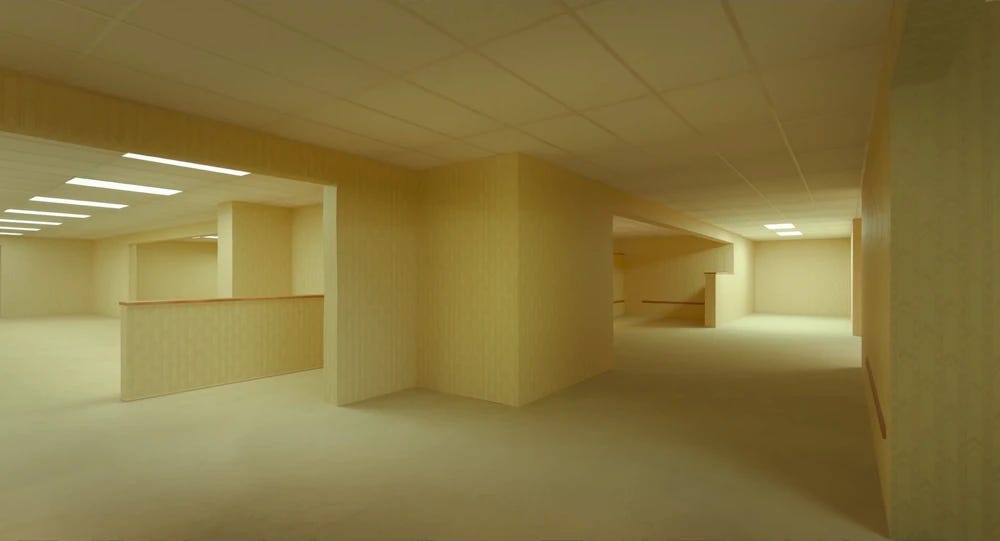
That movie shot by a 20-something based on a niche internet phenomenon is the best performing film for A24, that super hip movie studio that gave us Everything Everywhere All At Once, Marty Supreme, Hereditary and Midsommar. At a budget of 10 million dollars it right now sits at $256,884,832 at the box office. The movie roots itself in internet lore of urban exploration and liminal spaces and is basically an adaptation of a cursed image posted to 4chan in 2018, first turned into a series of YT-vids, then into a movie by the same director.
That, alone, have all kinds of outlets talking about the effects this will have on Hollywood, some already speak of a landslide revolution, another New Hollywood era using Youtube as an incubator for fresh new voices. All of that is cool and great, albeit you have to wonder why Hollywood is discovering Youtube as a talent incubator now — it’s a more than 20 years old repository of moving images after all featuring plenty of filmmakers for quite some time. Better late than never i guess, and there’s plenty of articles out there discussing this stuff. Here’s some recent headlines: From ‘Backrooms’ to ‘Obsession’: Why YouTubers Are Turning Hollywood Upside Down, Is the future of Hollywood nestled inside the backrooms of YouTube?, Reddit Is Ready to Be Mined for Hollywood IP, Why Backrooms and Obsession Are the Future of Movies, ‘Backrooms’ and ‘Obsession’ Offer a Memo to Hollywood.
But right now, i’m not so much interested in the new talent economics of moviemaking as awesome as that might be. Right now, i’m interested in the secret main actor in Backrooms. I’m interested in color.
(This analysis of Backrooms gonna contain some spoilers, so if you haven’t seen the movie yet, read on with caution.)
Soft Yellow and Spotlight Buff
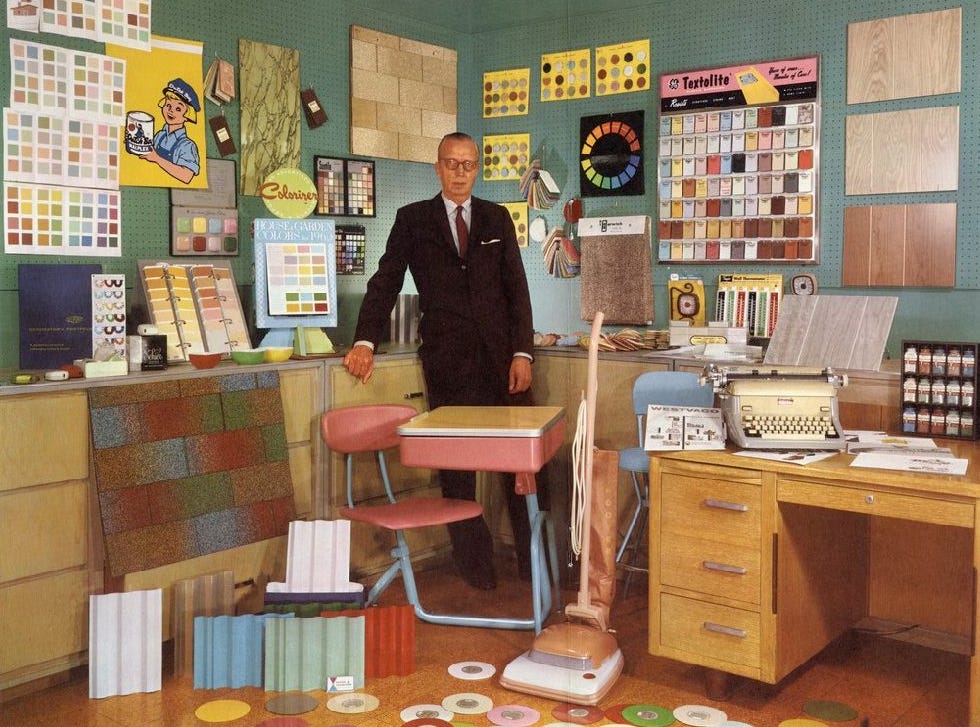
Faber Birren is one of the most famous color theorists of the 20th century. After pioneering the field in the 1930s, Birren “put color to work” and became a consultant for color psychology who worked with local businesses in New York and Disney’s animators on the design of Bambi, Fantasia, and Pinocchio. During WWII, he advised the military and hospitals aswell as GM, Monsanto and Du Pont when young men were recruited into war and the american industry had to be run by inexperienced workers. There, he developed his theory of functional colors and industrial color palettes.
Here’s one such palette from his 1963 book “Color for Interiors, Historical and Modern“. You gonna recognize some of those colors immediately.
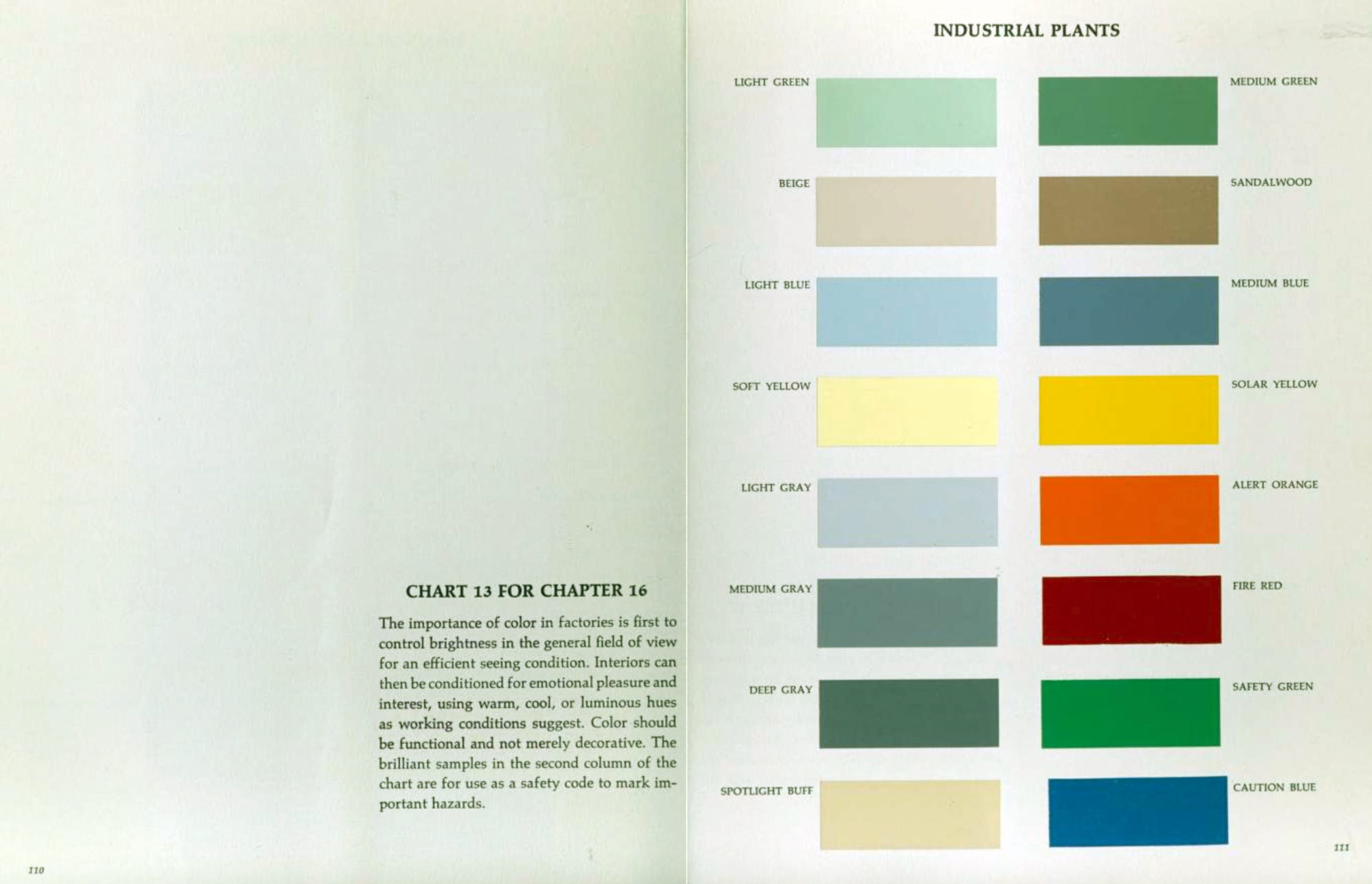
Those colors are what Birren termed “functional colors”, shades which are operationalized in commercial spaces, industrial plants or offices to subtly massage the psyche of workers into efficiency by providing psychological color-optimized conditions for labor.
Birren devotes much of his book on recommendations for these spaces. In general, walls should neither be full white nor come in intense signal colors as those would distract workers from the tasks at hand. Preferably, one should paint walls in soft, toned down palettes to “overcome eyestrain” and “aid the cause of good visibility and human efficiency”, and “in stairwells and corridors, usually deprived of natural light, bright tones of yellow are effective”. To Birren, “Neutrality is found in yellow”. Accordingly, the Backrooms in the movie are endless halls, corridors and ever more weirdly shaped spaces, nearly all of them painted in “Soft Yellow” and “Spotlight Buff”1.
To evaluate colors, i took the original image from 4chan and color corrected it to get an impression of the orginal backroom2.
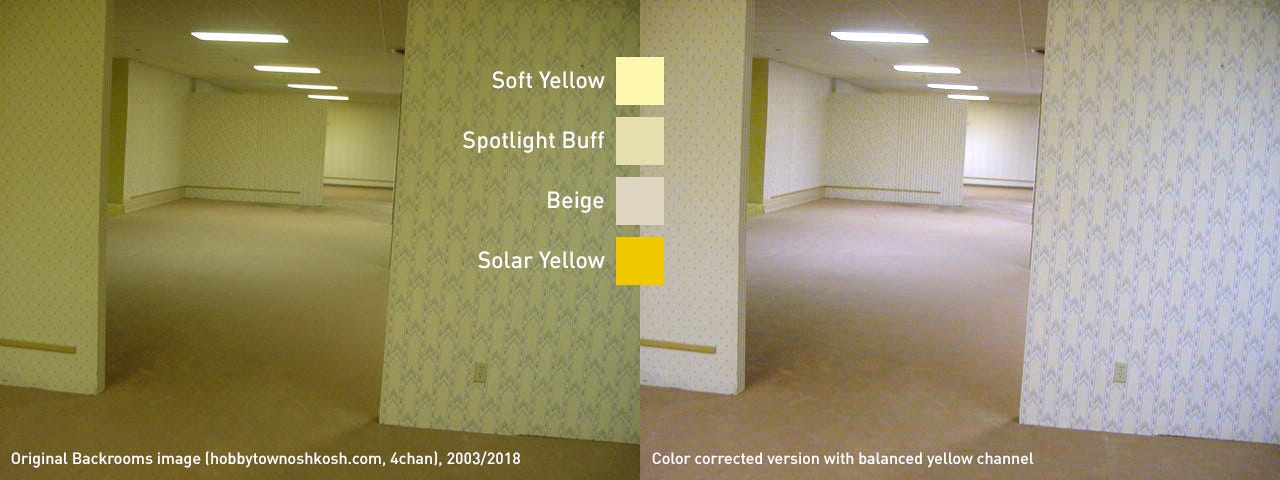
If you compare both images to the industrial color palette, you see that the soft tones are compatible and present in both versions, while the “Solar Yellow” for industrial use is absent. We’re not dealing with signal orange-y yellow here which is reserved for warning signs of danger and hazards, but with the soft creamy yellow tones that Birren recommends for stairways, corridors and hallways in industrial spaces.
However, Birren warns about the monotonous use of color and he would’ve stand back in horror —as we do!— looking at the endless soft yellow madness of the Backrooms:
If chaos and disorder are mentally and emotionally distressing, unrelieved monotony is probably worse. The theory is personal with the author; but the superstition that bizarre designs· and gaudy colors will “drive people crazy” has less verity to it than the one that attributes the same effect to situations which are precisely the reverse. That is, any human being forced to work in an office or home surrounded by nothing but ivory or buff will hazard his good disposition and sanity even more. A circus is less likely to make a person neurotic than the tan waiting room of a railroad depot!
To Birren, the beauty of color “needs control if it is to serve practical ends”. In the Backrooms, the “mentally and emotionally distressing, unrelieved monotony” of yellow and the “considerations as to the ‘quality’ of the light, the color tint of the surrounding brightness, the beauty, proportion, and balance of the interior itself” all are clearly out of control. Something is unleashed here and yellow spills everywhere.
In contrast to this monotone overflow of yellow, when applied with thought and “considerations”, according to Birrens book “Color Psychology and Color Therapy“, the “softness of color has a centripetal (centering) effect, removes outside distraction and is conducive to mental concentration”.
So much so that he then quotes a study done by the Public Buildings Administration in Washington and the U.S. Public Health Service to underline his theories in functional color3.
A controlled study was undertaken to measure the working · efficiency of a group of employees using business machines. Three. conditions were analyzed: (I) the original room; ( 2) the room with the addition of new lighting fixtures; ( 3) the room with the further addition of color. (…)
As to worker efficiency, one task had an improvement of 37.4 per cent. However, a fair and conservative figure of 5.5 per cent has been set as the general improvement shown. In cash value, this 5.5 per cent production improvement was equivalent to a saving on gross payroll of $13,229 among some 95 government employees.
He proudly calculates that the application of functional color, like “Soft Yellow” or “Spotlight Buff”, saves 139.25 bucks annually per average employee in american industry. Some very efficient shades of yellow we have here.
He sums up his productivity enhancing color theory like this:
In theory as well as practice, the purpose of color is not so much to “inspire” the worker; too much of this attitude may lead to distractions and irrelevancies. On the contrary, color becomes integral with the task, not foreign to it. Improved efficiency and relief from fatigue become automatic because the human eye can see more easily, with less strain. Color is made to fit in rather than stand out. It contributes to better visibility and to an agreeable and cheerful frame of mind.
An agreeable and cheerful frame of mind, which, at the end of Backrooms, breaks Clark and makes him appease to the grotesque labyrinth and its monstrosities. We’ll come back to this yellow-induced agreeableness.
Work Hard, Play Hard
There’s a great german documentary called Work Hard, Play Hard. Here’s the trailer with english subs, the movie is also on Youtube in full.
I always considered Work Hard, Play Hard as a kind of horror film. It’s one of my favorite movies actually, a non-narrative documentary showing the everyday goings in an assessment center in Hamburg, where young folks are interviewed for management job positions in big companies. It’s all stock full of people working on laptops talking in finest business jargon, and it’s all dead and hollow, especially because it’s so shiny happy positively challenging while being absolutely bureaucratic and all humanity is as calculated as an excel sheet. The documentary starts with a recruiter asking an applicant what work means to him, and his first one shot answer is “Joy” (ofcourse) and that he “likes success” (ofcourse).
After this initial interview the film cuts to three architects discussing a briefing for a new building for Unilever in Hamburg. Here’s a screenshot from that segment, showing an architectural rendering. You’ll recognize the colors.

The briefing is full of (absolutely not AI-generated but still 100% synthetic) business jargon and talks about how the architecture and interieur must be “contemporary” and “energetic” to show off “core values” as “a symbol for the beginning of a journey into a modern and dynamic future, representing the new spirit of the company” and so on and so forth.
When the designers discuss the briefing, they talk about how the architecture should “generate emotional worlds” through the “programming by a new building”, and that the structure should “convey that you are not forced to work”. It should be a place where you shall be “under no circumstances be reminded that you are working”. It must be noted that the designers do never talk about an actual absence of force or dependency here, they only talk about the architectural-symbolic mediation of such absence: The building must lie to the worker and lull her into the neoliberal illusion of work as joy.
In design for buildings and their architecture form always follows function, they rarely serve pure aesthetic purposes alone. You live in them, you do stuff, you wander around or you work. Especially for commercial spaces and office buildings, functionalism is imperative and Faber Birrens theory of functional color fits right in. The spaces provide psychological color-optimized conditions for labor, but that optimized condition is one of forgetting and illusion, where the worker “under no circumstances (shall) be reminded that (she is) working”. The color-optimized labor condition is one of distorted memory and alienation. It shall never appear to you that you are forced to work for a living and it is imperative for the architecture that you will stay under the illusion that you’re not caught up in a wage dependency on commodity labor. The efficiency gains of soft yellow and the “agreeable and cheerful frame of mind” mentioned by Faber Birren must be seen in this context of the erasure of the material realities of work.
In an interview, when asked about the use of monotone soft yellow in his movie, director Kane Parsons mentions associations with confinement, a state of being forced to stay in a closed or restricted space, and he connects soft yellow with “forced coziness”. This, precisely, is the “subtle massage (of) the psyche” i talked about above: Color and space which lulls you into “agreeableness”, to make you forget you are part of a machine. Backrooms is a horror movie about the resulting cognitive distortions haunting you in an endless labyrinthian memory palace. This manufactured memory distortion, enforced by architecture and color use in commercial spaces, is the ultimate evil in this movie which is unleashed and out of control.
Simulation Rooms
The monotony of Soft Yellow and Spotlight Buff in Backrooms sometimes is broken when the fleeing protagonists discover rooms with walls completely covered by photo murals of a beach including a ceiling covered by a photo of a blue sky, or they suddenly tumble into complete outdoors looking strangely synthetic. Birren would be pleased that finally, someone interrupts the sameness of endless neutral Spotlight Buff and hands Clark some “relief from fatigue” of the eye.
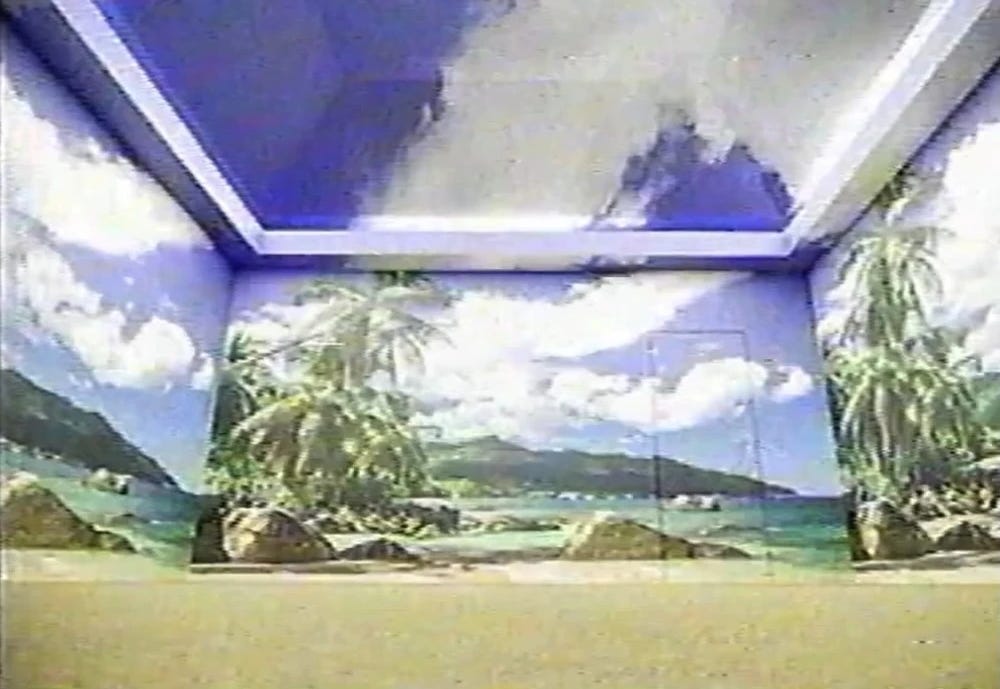
Such simulation rooms are designed to immerse a human into “artificial paradises”, as photographer Reiner Riedler termed them in his 2009 book on “Fake Holidays”. In the foreword of that book4, Bill Kouwenhoven writes that the “word paradise itself comes from the old Iranian Avestan language as ‘pairi.daêza’, meaning walled garden. As such, a paradise is also a controlled space that contains its own world view”.

The world view contained in Backrooms simulation spaces is one of total enclosure in economic optimization and efficiency — the outside world appears as surface decoration inside a commercial enclosure. Like in Baudrillards Hyperreality, the signifier has been completely detached from any experiental referent: In those “artificial paradise” beach-rooms, you are not supposed to enjoy a summer breeze at the ocean, you are there to efficiently spend leisure time, to faux-relax for the psychoarchitectural purpose of economic optimization, to squeeze another dollar to add to the 139.25 bucks anually saved per Faber Birrens average employee in american industry.
Leisure here is just the term for time spent outside of productivity. Under neoliberalism, there is no true freedom from work, as philosopher Byung-Chul Han analyzes in his book “Vita Contemplativa”. To him, the neoliberal imperatives of efficiency even colonize our understanding of rest, and writes that “leisure time is tied to the logic of work”. In neoliberal capitalism, leisure is an absence of actual freedom.
In Backrooms, such faux-resting rooms of operationalized rest are just another part of the labyrinthian nightmare, a false promise of escape for Clark and his therapist Mary, where there’s just more and deeper rooms ahead. The movie is Baudrillards critique of the hyperreal turned literal, where simulacra levels reveal themselves in various stages of an ever more outlandish architectural maze. The Backrooms only get weirder from wherever you are.
The Hauntology of Non-Places
In his short essay on “Ghost Modernism”, Mark Fisher contrasts model cities and urban planning with organic urban growth, and how the family and communal life got erased by capitalist interest expressing itself in architectural structures. Spotlight Buff and Soft Yellow in the endless Backrooms is one neutral friendly painted detail of this erasure. The architectural weirdness of the movie is a perfect expression of Mark Fishers unease with neoliberal modernity.
Clark is trapped in a “non-place” outside of time, where objects, space and people are “not remembered right” and appear as M.C.Escherian architecture and cronenbergian deformations called “Still Lifes”. This is an aesthetic expression of Fishers’ Ghost Modernism pushed to the extreme. Not only is public space turned into commercialized location, but the economic and personal private have collapsed into Clarks mind. He not only works in the furniture store, he sleeps and lives there, he’s totally enclosed in a job he hates, hunting for a lost dream of being the architect he insists he actually is: “I am a fucking architect! I’m just stuck selling shit furniture because someone won’t get off their fat fucking ass and help me.”
Mark Fisher argued that capitalism privatizes stress, writing that “it is necessary to reframe the growing problem of stress (and distress) in capitalist societies. Instead of treating it as incumbent on individuals to resolve their own psychological distress, instead, that is, of accepting the vast privatization of stress that has taken place over the last thirty years, we need to ask: how has it become acceptable that so many people, and especially so many young people, are ill?”
Backrooms directly adresses this privatization, represented in Clarks dutiful-while-frustrated obedience to his job and his regular visits to his therapist who writes self-help books about “The Window Within”. Stress, for Clarke and his therapist, is his own fault. Like any good neoliberal citizen would do he accepts that his depressions and frustrations are his personal business only to solve for himself, they are not the outcome of an encapsulation of the private in shallow economic spaces.
This is Fishers “vast privatization of stress”. In Fishers reading, therapy is not a psychological tool of liberation, but a tool to re-adjust the patient to an unlivable environment. Psychoanalysis is just as caught up in the maze as poor Clark who is doomed to run around in circles in a closed loop of mental survival, navigating a maze constructed from the very corporate aesthetic that killed his ambition, and while running he’s massaged by the “forced coziness” of functional color and architecture to seek guilt within himself. The labyrinth is Clarks own mind in which neoliberal necessities swallowed his dreams. No escape, nowhere, and no help in sight.
In The Weird and the Eerie, Fisher defines the eerie as a failure of absence or a failure of presence, constituted either by a presence where there should be nothing, or an absence where there should be something. The endless maze of the Backrooms are weird renderings of that fisherian eerie: They are perfectly painted in Birrens functional color, they come with occasional simulation rooms to productively “relax”, yet there is an absolute absence of the human that should occupy it.
Director Parsons talks about this eerie absence of architecture devoid of humanity in another interview: “I’m interested in the neglected. There’s something about a well-maintained, very active, lively office building where there’s not one person in that building being sentimental about the space itself. It feels like the building is there to fulfill a job and it has no friends whatsoever. It will be moved out of and no one will ever think about that space again.”
To Parsons, the pure functionalism of Birren and the perfected office spaces shown in Work Hard Play Hard are an architectural tragedy for the building itself, which has been stripped of any organic communal activity, only to make place for pure economic efficiency. To him, Backrooms “is a building ghost story, where you have a sort of mega structure concept of places that are not meant for human inhabitants, but are just close enough to feeling like they are potentially livable”.
What Parsons describes here is an architectural uncanny valley, in which a thing appearing almost human will cause eerie feelings: The spaces in Backrooms are “close enough” to be “felt” as “potentially livable”, but they actually are not. They are painted in soft yellow neutral tones designed to absorb friction in friendly neutrality, but those rooms have been decoupled from any actual human activity. The Soft Yellow becomes the ambient representation of an eerie invisible systemic force, something Kane Parsons refered to in the same interview as a “force of nature”. This is Fishers Capitalist Realism in essence: an exhaustion of imagination, where the subconscious mind can only wander through repeating patterns of commercial space. The only thing actually present in those repeating patterns are Clarks distorted memories of people and his divorced wife, deformed into the body horror of the “Still Lifes”.
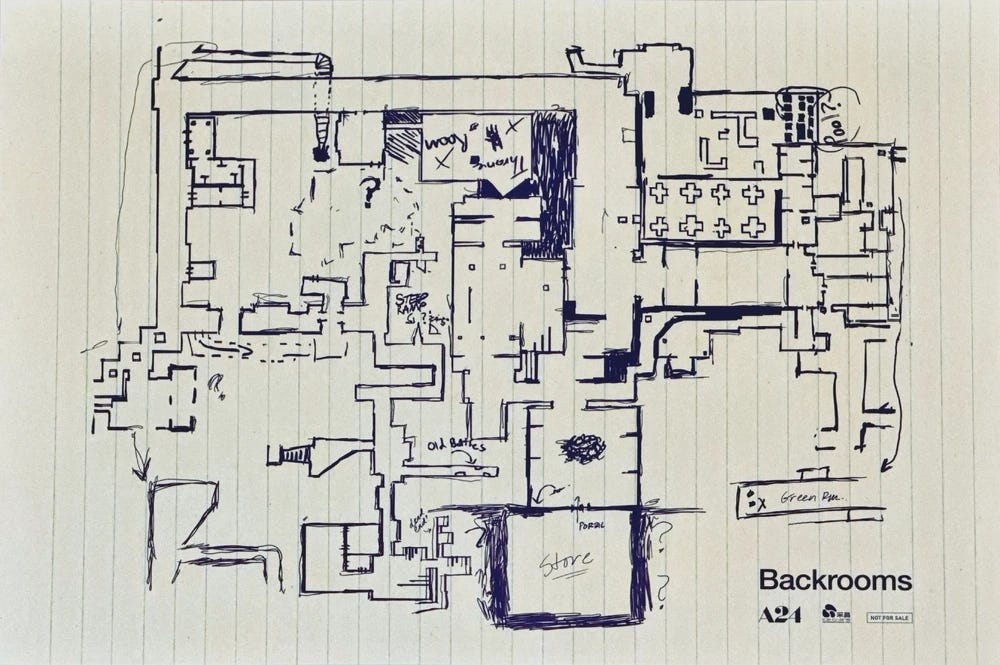
The Fisherian dimensions in Backrooms are obvious: We are lost in an inescapable labyrinth painted in institutional soft yellow, surrounded by the warped remnants of our dreams which are “not remembered right” coming to haunt us, equipped only with selfdrawn maps and crude scribblings on the wall, listening to the low-frequency hum of neon lights. Sometimes, we get simulation rooms and fake beaches. We work hard, we play hard, and then we get eaten.
Kafka nods
Ultimately, Clark surrenders to the Backrooms. He accepts his fate, stops wandering around, has built himself a new home and admits that he does not want to change: “I like it in here. For the first time in a long time i feel like i am where i was supposed to be.”
When the weirdness of the labyrinth represents the human caught in the fisherian madness of a neoliberalism out of control, then this “agreeable” surrender to the labyrinthian nightmare is the final kafkaesque turn. Both Fisher and Kafka analyze the human experience as trapped in the systemic, bureaucratic, economic, but where Fisher diagnoses an inability to imagine alternatives to capitalism, Kafka shows that we turn this failure against ourselves.
Franz Kafka in his novels wrote about institutional guilt from opaque outside circumstances that is forced on the individual which can’t help but internalize that guilt. Josef K. in “The Trial” is arrested without being told his crime, but he behaves as if the accusation must be meaningful. K. in “The Castle” seeks access to an authority that is always near and always out of reach. Gregor Samsa in “The Metamorphosis” wakes as an insect and his first thoughts are about work obligations and a missed train.
In Backrooms, Clark is trapped in a state of neoliberal limbo and fails to imagine a life outside of it. Parsons says about Clark, that he’s “feeling quite stuck”, and that “he’s not quite understanding that he’s free to move outside of where he is right now”. This is Clarks kafkaesque acceptance of guilt: He can’t imagine to ever live outside the Backrooms, or to move on beyond distorted memories and economic necessities, and turns that failure against himself.
The movie is very consequential about this: The moment Clark surrenders to the fisherian “privatization of stress” and apologizes, he’s eaten alive by the representation of his capitalist deformation, the giant, blown out or proportion pirate mascot that is himself as a frightened, grotesque creature. As Mark Fisher writes in Ghosts of my Life, “Everything comes back as an advertising campaign.” Clark is literally devoured by the corporate brand identity he created to survive under capitalism, a commercial mascot for the furniture store where he was forced to live and sleep, to give up on his dreams and die.
This is a kafkaesque horror within the fisherian eerie: Clark experiences the labyrinthian trap as deserved, structural necessary, and impossible to appeal. He seeks help from a therapist who writes self-help books and who disregards true understanding only to discover that Clark was right. In Kafkas terms, the maze is a court, and a castle, and the endless corridors you have to wander without ever finding salvation. As Clark adapts to his internalized fate of guilt, it swallows him completely. The punishment is not imposed from an outside, it is generated from the semiotic material of Clarks own life. The signifier consumes the signified in an act of baudrillardian cannibalism.
At the end, the movie leaves no one unscathed: In the final act, when psychotherapist Mary barely escapes the Backrooms only to land in the research facility of Async, it is not clear to the audience what reality in this movie exactly is, as she wonders “Where am I right now?” We don’t know either, when in the last frames she is seen as another deformed “Still Life” memory-image.
We are left to ask, are we trapped in the mind of someone? Is the reality of the film a recursive dream of an architectural structure? Is the world a series of interconnected labyrinth-minds which we can access through interdimensional portals like in Being John Malkovich? The film suggest we all are trapped in such puzzles impossible to solve, enclosed in our own versions of the Backrooms. Me, you, everyone. Institutions won’t help, while psychoanalysis and therapy ultimately fail.
In the face of such a fundamental uncertainty, where economic necessity of survival is turned into personal guilt and giant symbols swallow the symbolized, maybe the best thing, then, like Mary at Async, is to first state the obvious: “I walked through a wall, in the basement of a furniture store.”
I could go on.
Backrooms is full of symbolism and i haven’t even mentioned the bird which might or might not be related to M.C. Escher, i haven’t gotten into Mary’s childhood and her schizophrenic mother or the cutout cavemen, all of which invite for further explorations. I haven’t drawn parallels to Vaporwave and Mallsoft music, and my remarks on Kafka only scratch the surface. I haven’t seen a film so rich in subtext for a very, very long time.
It’s an astounding movie on it’s own, made even more astounding given it’s backstory. Kane Parsons just turned 21 years old these days —Happy Birthday!—, and the box office story of Backrooms must be read not just as a succesful youtube exploit of meme culture, but as a cultural expression of post-work movements which grew particularly popular with GenZ post-covid.
This is a horror movie about the erasure of wage dependency from collective consciousness through all-encompassing neoliberal ideology and its aesthetic of “forced coziness”, on display in soft yellow painted walls and the shiny happy challenges of a “Work Hard, Play Hard”-culture. The film shows us the terror of the resulting cognitive distortions, internalized guilt and alienations from our dreams.
Backrooms, including its unlikely success story, is itself a portal, to make visible that entrapment, to step outside of it and have a look — and to crack open the possibility of dreaming up unknown, yet unimagined futures.
GOOD INTERNET ELSEWHERE // Bluesky / Mastodon / Threads / FB / Insta
SUPPORT // Patreon / Steady / Paypal / Spreadshirt
Musicvideos have their own Newsletter: GOOD MUSIC. All killers, No fillers.
Thanks for reading.

The name “Spotlight Buff” has its etymological roots in buff, “the colour of undyed buffalo leather, such as soldiers wore as some protection” and was first mentioned in The London Gazette of 1686. According to Wikipedia, “such buff leather was suitable for buffing or serving as a buffer between polished objects.” An approriate name for a color used in liminal spaces which are “between” things by definition.
The whole “We found the original Backrooms stuff” is it’s own kind of swarm intelligence webculture genre. From KnowYourMeme: “On May 30th, 2024, Twitter / X user @tjxz_z uploaded a post that claimed their friend found the real place of ‘The Backrooms’, which is in Wisconsin, while the photo was taken in 2003.” Here’s a video showing more photos of the Backrooms location, here’s another clip on Bader’s Furniture. Internet sleuths also found the original wallpaper, here’s a video telling that subplot of the Backrooms lore, here’s the clip by the guy who found it.
Birren was also very interested in what we call synaesthesia today, where the perception of color gives rise to secondary sensory effects in sound, taste, smell or touch. Some people, for instance, hear sounds when they see intense colors, or they smell stuff when they hear music. In his book “On Color Psychology and Color Therapy”, he claims that “pale yellow (is) perhaps (one of) the best ‘smelling’ colors”, which makes sense as soft yellow is visually correlated with cake. That’s quite a contrast to some more icky associations we have with greenish soft yellows connecting them to sickness and pus, something Kane Parsons mentions in interviews. The smell of Spotlight Buff is weirdly ambivalent.
Another photobook on the same topic with a different focus would be Zed Nelsons “The Anthropocene Illusion” which examines our preference for simulations and the resulting divorce from nature